

The Governance Paradox
Why AI Needs Decision Context, Not Just Data Catalogs.
Reframing data governance as a decision-making capability.
Most data governance programs do not stall because the catalog is weak. They stall because meaning is not yet owned like a decision.
We see the same pattern across industries: Organizations deploy a modern tech and data stack, appoint data stewards, and publish policies—yet day-to-day work doesn't create data that is fit for purpose.
Teams still reconcile numbers before meetings. Leaders still ask for 'the real' revenue. Data scientists still spend a disproportionate share of their time stitching context across systems instead of improving outcomes.
This is the Governance Paradox: The more we treat data purely as an IT asset, the less governable it becomes for the decisions that matter.
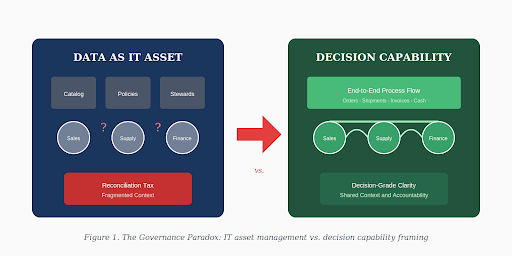
The 'Reconciliation Tax'
Consider a standard demand planning scenario in a CPG company. You have three domains, three owners, and three definitions of 'customer':
Sales tracks accounts by billing entity.
Supply Chain tracks ship-to locations.
Finance tracks revenue by legal entity.
Each definition is 'correct' in its own context and domain. Yet none of them can answer a simple end-to-end question: What did this customer actually order, when, and why did we miss the delivery?
Why? Because the highest-value signal rarely lives inside a single domain. Value lives in the seams, in the hand-offs: orders, constraints, overrides, approvals, and exceptions. These are the real-world adjustments that determine whether plans translate into service provided and revenue.
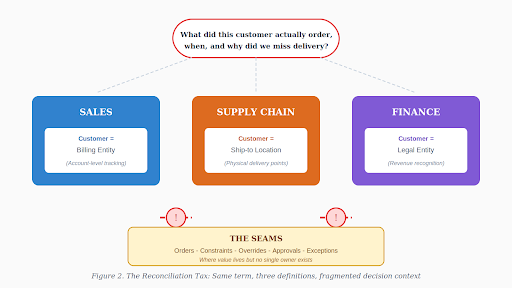
When the seam or the problem statement has no single owner, it naturally falls between domains. And when the seam is not governed, the decision context stays fragmented—no matter how capable your data platform is.
The result is a hidden 'Reconciliation Tax' that organizations pay every day in time, attention, and delayed action—before you even count delayed decisions and downstream model drift.
A Better Framing: Governance as Decision Capability
The organizations making progress do not try to 'do more governance.' They reframe and embed it.
They treat governance as a decision-making capability: a way to create clarity, accountability, and learning across end-to-end processes, rather than a documentation exercise.
Three shifts consistently separate governance that produces outcomes from governance that produces artifacts.
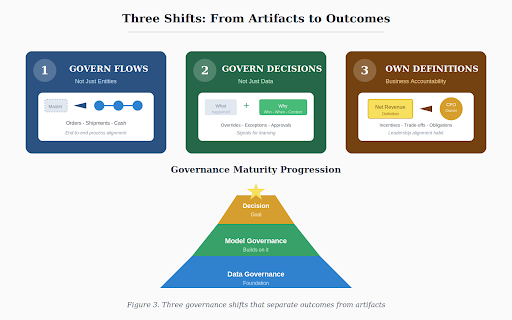
1. Govern Flows, Not Just Entities
Traditional governance starts with static objects: customer master, product master, vendor master. That work is necessary, but it is insufficient. Business value is created through processes: Orders drive shipments. Shipments trigger invoices. Invoices result in cash. Forecasts become plans, which become inventory, which becomes availability.
If governance stops at the domain boundary, your analytics and AI will too. Process governance aligns definitions and accountability around the end-to-end flows where the business actually wins or loses.
2. Govern Decisions, Not Just Data
Transactions tell you what happened. They rarely tell you why. The planner override. The exception discount. The rejected outlier. These are not anomalies to be ignored; they are signals to learn from. They reveal how the organization adapts to reality and manages trade-offs.
Organizations that scale AI successfully treat these decision points as first-class assets. They capture the context—who changed what, when, and why—so it can be explained, reviewed, tracked, and improved.
Data governance is the foundation. Model governance builds on it. Decision governance is the goal. The objective is decision-grade clarity: definitions, context, and traceability that hold up in real workflows.
3. Put Definitions Where Accountability Sits
If the business does not own the definition, governance struggles to become operational. It stays descriptive. Terms like 'net revenue,' 'on-time,' and 'active customer' are not math problems. They are a result of incentives, trade-offs, and obligations.
Until accountable owners commit to a shared meaning and accept the consequences, the organization will keep paying the reconciliation tax. High-performing companies make definition alignment a leadership habit.
Why This Matters Now: The AI Imperative
This is no longer only about reporting accuracy. It is about AI readiness.
Every AI system inherits the semantics, constraints, and ambiguity of its underlying data. As model capabilities advance, the limiting factor shifts from algorithms to meaning and accountability: Can you explain what your core terms mean and who stands behind them? Can you trace a prediction back to its evidence?
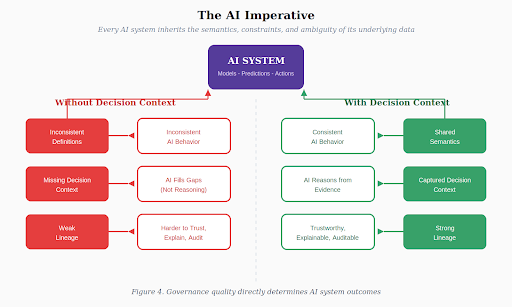
The Point
This shift does not work as a standalone 'data governance program.' Catalogs, policies, and stewardship roles help; but they do not, by themselves, create decision context.
In this framing, decision context is governance: shared semantics, situational details (constraints, overrides), and traceability embedded directly in the workflows where outcomes are produced.
Start with one end-to-end flow where the friction is visible. Make the seam owned. Define the terms that matter. Capture the overrides, approvals, and exceptions at the moment work happens, not as an after-action documentation step. Demonstrate value fast, then scale the pattern to the next flow.
The goal is not governance of artifacts for their own sake. The goal is a business that can explain itself—its definitions, its decisions, and its outcomes, consistently, end-to-end.
That consistency is what enables AI + Human collaboration at scale. Not as overhead. As a competitive capability.